
Mastering the Basics of Budgeting in Five Simple Steps
Why So Many People Struggle With Money (And What Actually Fixes It)
Budgeting 101 for beginners is exactly what it sounds like: the core steps you need to take control of your money, starting from zero.
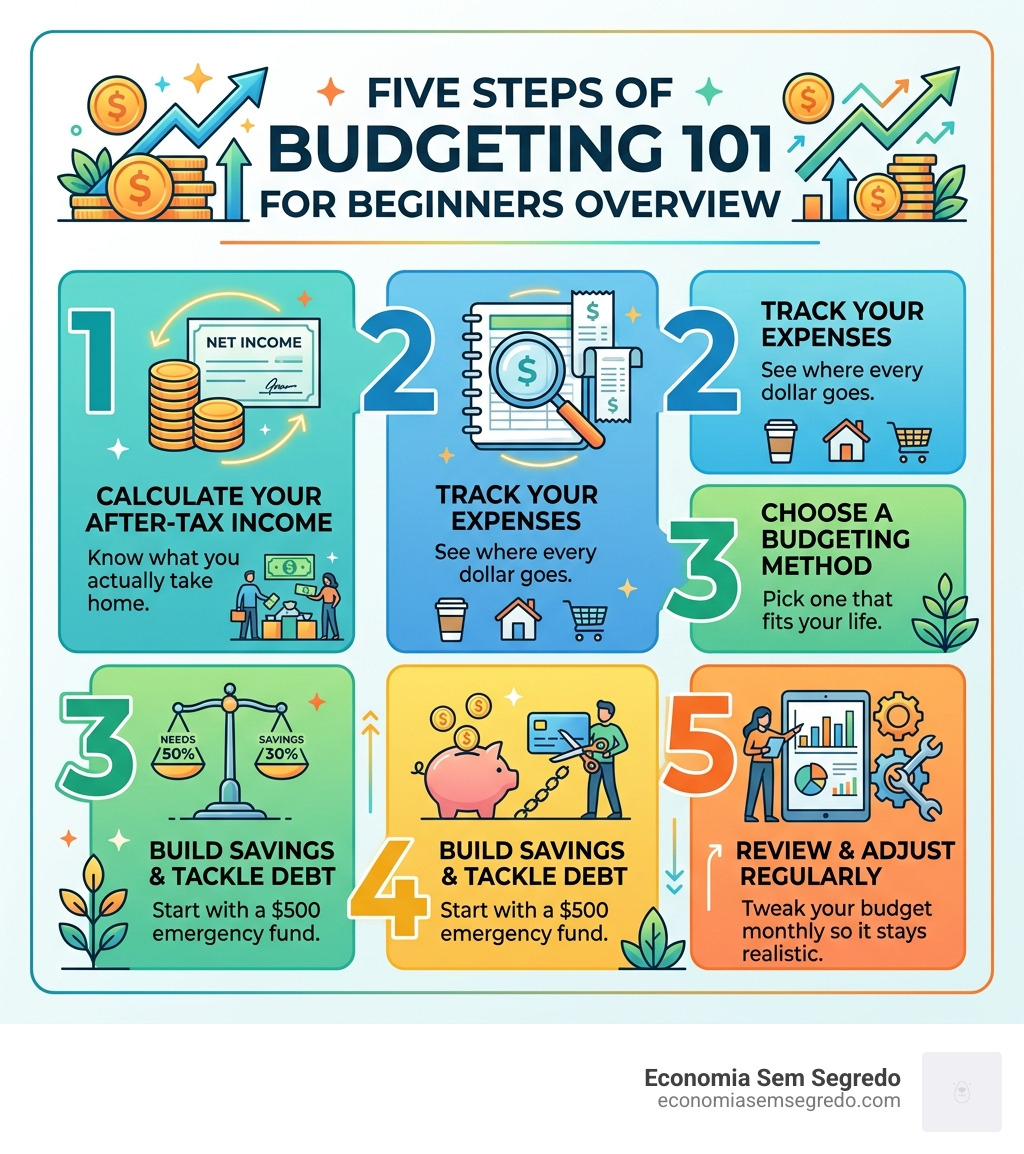
Here’s a quick overview of the five steps this guide covers:
- Calculate your after-tax income — know what you actually take home
- Track your expenses — see where every dollar goes
- Choose a budgeting method — pick one that fits your life (like the 50/30/20 rule)
- Build savings and tackle debt — start with a $500 emergency fund, then grow from there
- Review and adjust regularly — tweak your budget monthly so it stays realistic
Managing money feels overwhelming for a lot of people. And in 2026, the pressure is real — 51% of Americans say prices will get worse this year. That’s not a small number.
The good news? A budget doesn’t have to be complicated. At its core, a budget is simply a plan for how you use your money. It helps you cover your bills, build savings, and reduce financial stress — no accounting degree required.
Think of it like a GPS for your finances. You don’t need to know every turn in advance. You just need a starting point and a direction.
This guide walks you through five simple steps to build your first budget and actually stick with it.
Understanding Budgeting 101 for Beginners

When we talk about budgeting 101 for beginners, we aren’t talking about deprivation or “giving up everything you love.” We are talking about building a financial roadmap. Think of your budget as a tool for financial health. Just like you wouldn’t set out on a cross-country road trip without a map (or at least a very reliable GPS), you shouldn’t navigate your life without a plan for your money.
Budgeting is essentially the act of balancing a scale. On one side, you have your income; on the other, your expenses. The goal is to ensure the scale never tips too far toward the expense side. In fact, a perfect budget creates a surplus—extra money at the end of the month that you can use to build your future.
Why does this matter? Beyond just paying the bills, having a plan reduces the mental load of “money talk.” Research has shown that proactive financial planning can significantly lower psychological stress and improve overall well-being. According to Scientific research on the impact of financial planning on mental stress, individuals who engage in structured financial management report feeling more in control and less anxious about unexpected life events.
By mastering the basics, you move from reactive spending (wondering where your money went) to intentional spending (deciding where it goes). This transition is the foundation of responsible spending and long-term wealth.
Steps 1 & 2: Income Calculation and Expense Tracking

The first step in any budgeting 101 for beginners journey is knowing exactly how much fuel you have in the tank. This sounds simple, but many people make the mistake of budgeting based on their gross salary—the big number at the top of the offer letter.
To create a budget that actually works, you must use your net income (also known as take-home pay). This is the amount that actually hits your bank account after Uncle Sam and your employer take their share.
When calculating your income, don’t forget to account for pre-tax deductions. If your employer deducts money for health insurance premiums or 401(k) contributions, you should actually add those back into your “total income” for budgeting purposes if you want a full picture of your financial life. However, for a “bare-bones” budget, focusing on the cash you can spend is the safest bet.
| Income Type | What’s Included | Why it Matters for Budgeting |
|---|---|---|
| Gross Income | Total salary before any deductions | Used for tax brackets, but misleading for daily spending. |
| After-Tax (Net) Income | What you see on your paycheck | This is your actual “spending power.” |
| Pre-Tax Deductions | 401(k), HSA, Insurance | These are “forced savings” or “needs” already paid. |
Budgeting 101 for Beginners: Distinguishing Needs from Wants
Once you know what you earn, you need to see where it goes. This is where most people get a “reality check.” We often think we know what we spend, but the data usually tells a different story.
A critical part of budgeting 101 for beginners is learning to distinguish between a “need” and a “want.”
- Needs: These are non-negotiables. Housing (rent/mortgage), groceries, basic utilities, transportation to work, and insurance.
- Wants: These are lifestyle choices. Streaming services, that new pair of sneakers, and dining out.
Speaking of dining out, the average American spends about $232 per month on food prepared outside the home. While that might seem like a small luxury, it adds up to nearly $2,800 a year! Furthermore, roughly 40% of food in the United States goes uneaten, which is essentially throwing $165 billion into the trash annually. Understanding these habits is key to finding “hidden money” in your budget. For more on how our habits impact our wallets, see the Scientific research on consumer food waste and spending.
Tracking Tools for Budgeting 101 for Beginners
How do you track all of this? You don’t need fancy software, though it can help. Here are the most common methods:
- Mobile Apps: Great for real-time tracking and syncing with your bank accounts.
- Spreadsheets: Perfect for those who want total control and customization.
- The Notebook Method: Old-school but effective. Writing down every purchase by hand creates a psychological barrier to overspending.
- Receipt Organization: Keeping a folder for the month to review at the end of the week.
The goal isn’t to be perfect; it’s to be aware. Tracking for just 30 days will reveal spending habits you never knew you had.
Step 3: Selecting Your Budgeting Method
Now that you have your data, you need a system. A budget isn’t a “one-size-fits-all” suit; it’s more like a customizable financial lifestyle. If a plan is too rigid, you’ll quit. If it’s too loose, you won’t save. You have to find the “Goldilocks” zone of realistic limits.
The 50/30/20 Rule
For most people starting budgeting 101 for beginners, the 50/30/20 rule is the gold standard. It’s simple, flexible, and ensures you are covering all your bases.
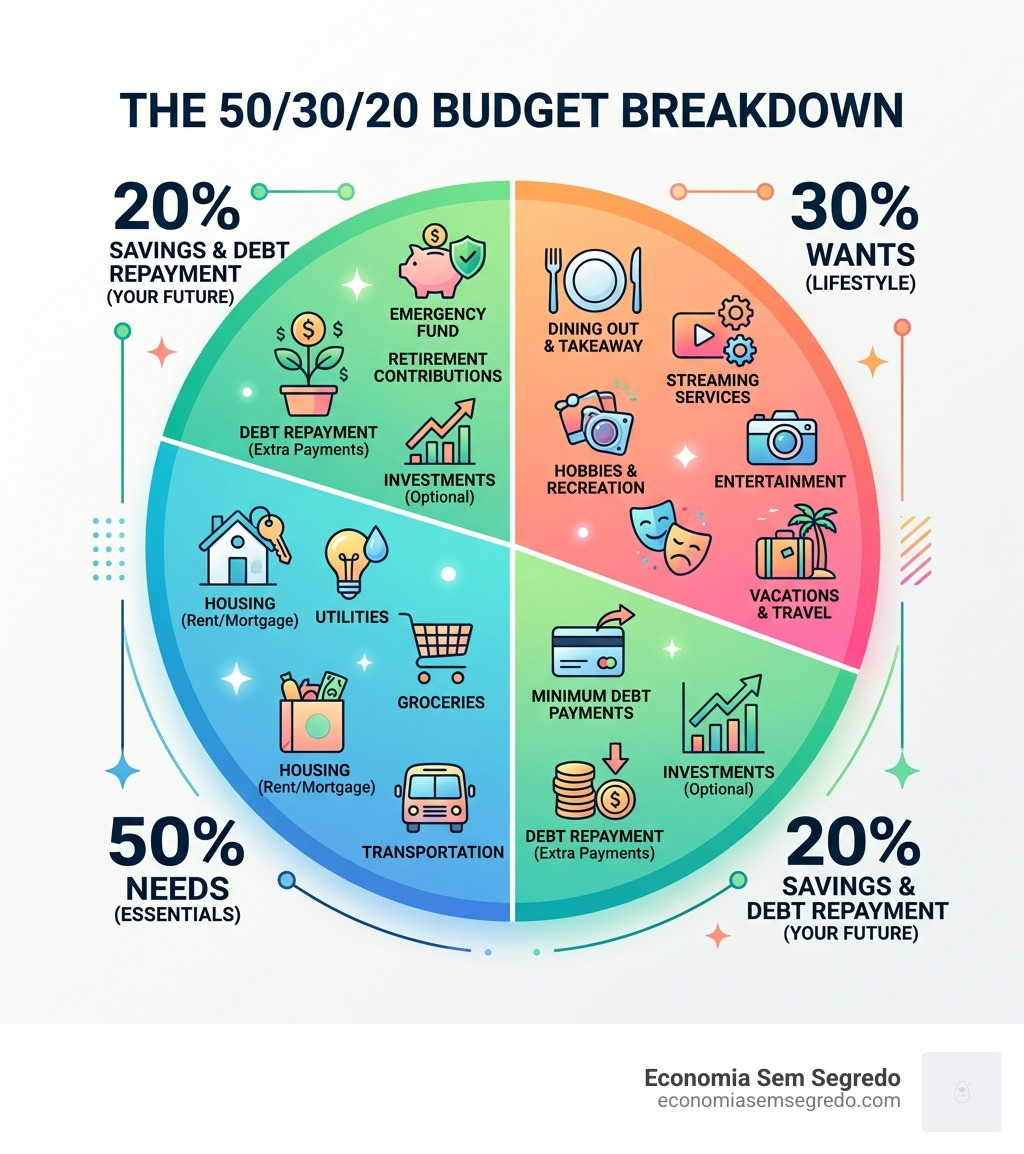
- 50% for Needs: Half of your after-tax income goes to the essentials (housing, utilities, groceries, minimum debt payments).
- 30% for Wants: This is your “fun money.” It covers hobbies, vacations, and dining out.
- 20% for Savings and Debt Repayment: This is the most important category for your future self. It includes building an emergency fund, retirement contributions, and paying off debt beyond the minimum requirements.
If your “needs” currently take up 70% of your income, don’t panic. The 50/30/20 rule is a target, not a law. You might need to temporarily cut your “wants” to 10% while you work on lowering your fixed costs or increasing your income.
Zero-Based and Envelope Systems
If the 50/30/20 rule feels too vague, you might prefer a more disciplined approach:
- Zero-Based Budgeting: In this system, every single dollar is assigned a job. If you earn $4,000, you assign all $4,000 to categories (including savings) until you have $0 left. This prevents “lazy money” from disappearing into random impulse buys.
- The Envelope System: This is the ultimate tool for spending discipline. You put physical cash into envelopes labeled for specific categories (e.g., “Groceries,” “Entertainment”). Once the cash in the “Entertainment” envelope is gone, you don’t go to the movies that month. It’s a physical way to see your monthly surplus—or lack thereof.
Steps 4 & 5: Savings Priorities and Maintenance
You’ve tracked your spending and picked a method. Now, we get to the part that actually builds wealth: priorities. We often want to do everything at once—save for a house, pay off the car, and invest in the stock market. But for budgeting 101 for beginners, we recommend a specific order of operations.
Building an Emergency Fund and Paying Debt
Life happens. Tires pop, water heaters leak, and jobs can be lost. In 2026, 46% of Americans plan on prioritizing emergency savings. You should too.
- Priority 1: The Starter Emergency Fund. Aim for an initial goal of $500 to $1,000. This is your “buffer” against small disasters so you don’t have to reach for a credit card.
- Priority 2: The Employer Match. If your job offers a 401(k) match, contribute enough to get the full amount. This is essentially a 100% return on your money—don’t leave it on the table.
- Priority 3: High-Interest Debt. Focus on debt with interest rates above 7-8%. This usually includes:
- Credit card balances
- Payday loans
- Personal loans
- Title loans
- Priority 4: The Full Emergency Fund. Once the high-interest debt is gone, grow your savings to cover 3-6 months of basic living expenses.
- Priority 5: Retirement. Financial experts suggest saving 10-15% of your pre-tax income for retirement.
Reviewing and Sticking to Your Budget
A budget is not a “set it and forget it” document. It’s a living thing. We recommend monthly check-ins. Sit down with a cup of coffee (one you budgeted for!) and compare what you planned to spend versus what you actually spent.
The secret to long-term stickiness is avoiding rigidity. If you never allow yourself “fun money,” you will eventually “binge spend” and abandon the budget. Budgeting is a habit, like going to the gym. Some months will be better than others. If you overspend one month, don’t throw the whole plan away. Just adjust for the next month and keep going.
Frequently Asked Questions
How often should I adjust my budget?
We suggest a quick review every week and a deep dive once a month. However, you should also adjust your budget whenever a major life event occurs, such as a pay raise, a move to a new apartment, or a change in your monthly subscriptions. In budgeting 101 for beginners, flexibility is your best friend.
What are the most common budgeting mistakes for beginners?
The biggest mistake is being too optimistic. People often underestimate how much they spend on “miscellaneous” items. Another common pitfall is forgetting “irregular” expenses—like annual car registration or holiday gifts. To avoid this, create a “Sinking Fund” category where you save a little bit each month for those once-a-year costs.
How do I manage a budget with irregular income?
If you are a freelancer or work on commission, budgeting can feel tricky. The best strategy is to budget based on your “lowest-earning month” from the previous year. Any money you earn above that amount goes straight into a “buffer” account to cover you during the leaner months. This ensures your “needs” are always met, regardless of your fluctuations in pay.
Conclusion
At Economia Sem Segredo, we believe that financial peace isn’t about how much you make; it’s about how well you manage what you have. Mastering budgeting 101 for beginners is the first and most important step toward a life free from financial anxiety.
By following these five steps—calculating income, tracking expenses, choosing a method, prioritizing savings, and maintaining the habit—you are doing more than just “counting pennies.” You are building a foundation for your dreams, whether that’s buying a home, traveling the world, or retiring early.
Money management doesn’t have to be a secret. With clear guides and simple techniques, you can take control of your future today. Master your money with our budgeting guides and start your journey toward financial freedom. We are here to simplify the complex and make your financial goals accessible. Happy budgeting!
